Software engineering teams are no longer asking whether to use generative AI. They are asking how to deploy it without breaking delivery pipelines, compromising code quality, or creating security gaps that surface in production.
According to the Stanford AI Index 2026, 88% of organizations now use AI in some capacity, and generative AI reached 53% population penetration within three years. Yet adoption metrics only tell half the story. The same report notes that AI agent deployment across business functions remains in single digits, and documented AI incidents rose 55% year-over-year to 362 cases in 2025.
Teams that deploy generative AI without clear operational frameworks see short-term productivity gains followed by technical debt, security vulnerabilities, and integration failures that erode the initial advantage.
In this post, we break down seven practical ways how Generative AI is optimizing the software development from architecture decisions to production deployment.
How Generative AI Reshapes the Software Development Lifecycle
Generative AI refers to machine learning systems trained on large codebases, technical documentation, and design patterns that can produce original outputs such as functional code, test suites, API documentation, and UI components based on natural language prompts or existing project context.
Unlike traditional automation, which follows rigid rules, generative AI adapts to your codebase's conventions, learns from team patterns, and scales alongside your system architecture.
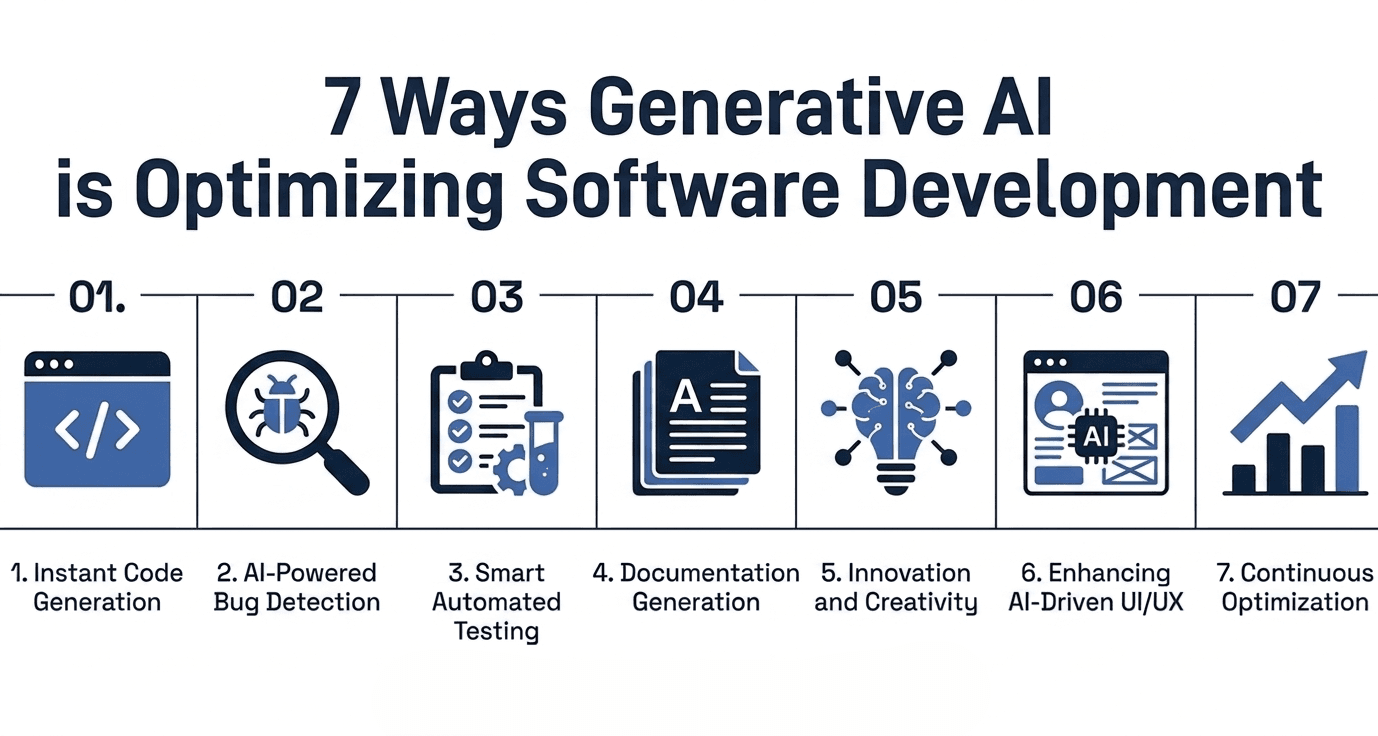
Below are seven practical applications where generative AI delivers measurable impact across the software development lifecycle.
1. Intelligent Code Generation: Accelerating Delivery
Developers no longer start from blank files. AI pair-programming tools like GitHub Copilot and OpenAI Codex generate boilerplate, algorithms, and entire functions from natural language descriptions or inline comments. This reduces cognitive load on repetitive implementation tasks and shortens development cycles.
Teams can prototype faster, iterate on features in hours rather than days, and redirect senior engineers toward system architecture and complex problem-solving instead of routine coding. The key is establishing guardrails so AI-generated code meets your organization's quality bar before it reaches production.
2. AI-Assisted Debugging: Catching Errors Early
Generative AI debugging systems analyze code context, stack traces, and historical bug patterns to identify vulnerabilities and suggest fixes in real time. These tools don't just flag syntax errors; they detect logic flaws, security vulnerabilities, and performance anti-patterns that static analyzers often miss.
The operational advantage: Reduced mean time to resolution (MTTR), fewer production incidents, and a feedback loop where the system learns from your team's past corrections. Over time, this prevents recurring issues and strengthens application security posture, critical for teams building enterprise systems where downtime carries significant cost.
3. Automated Test Generation: Expanding Coverage
Generative AI automates the creation of unit tests, regression suites, and UI test scripts by analyzing function signatures, edge cases, and user flow patterns. AI-generated tests achieve broader code coverage than manual scripting because they systematically explore boundary conditions that human testers often overlook.
QA teams shift from writing repetitive test scripts to designing test strategies, analyzing failure patterns, and validating complex integration scenarios. This reallocation of expertise improves software reliability while controlling quality assurance costs as platforms scale.
4. Living Documentation: Keeping Knowledge Current
Documentation traditionally decays the moment it is written. Generative AI reverses this by generating and updating documentation directly from source code. AI prompts developers to explain non-obvious implementation choices during coding, then expands those explanations into structured documentation.
This ensures onboarding materials, API references, and maintenance guides remain synchronized with the actual codebase, reducing the knowledge gap that slows team velocity when engineers rotate or systems age.
5. Architectural Innovation: Prototyping at the Speed of Thought
Generative AI enables rapid experimentation with design patterns, microservice architectures, and integration strategies. By generating code suggestions, architectural prototypes, and dependency analyses, AI allows teams to explore unconventional approaches without committing weeks of engineering time.
This capability supports digital transformation initiatives where legacy systems need modernization or new revenue streams require platform expansion. Teams can validate architectural hypotheses quickly, discard unworkable approaches early, and converge on robust solutions faster than traditional planning cycles allow.
6. Adaptive UI/UX Generation: From Design Intent to Functional Interface
Generative AI bridges the gap between design vision and implementation by producing UI components, responsive layouts, and accessibility-compliant front-end code from high-level descriptions or design system rules. These systems adapt interfaces to user preferences, device contexts, and accessibility requirements without manual recoding.
Design and development iterations compress from weeks to days. Product teams receive functional prototypes earlier, user feedback integrates sooner, and the final interface reflects actual user behavior rather than assumed patterns. This collaborative AI-designer-developer workflow is particularly valuable for customer platforms where user experience directly affects retention and conversion.
7. Continuous System Optimization: Building for Long-Term Scalability
By continuously analyzing runtime performance data, code complexity metrics, and user interaction patterns, AI systems suggest refactoring opportunities, resource optimizations, and architectural adjustments that improve efficiency over time.
The scaling advantage: Software systems naturally accumulate technical debt and performance degradation as features compound. AI-driven optimization identifies these decay patterns early. This creates the foundation for sustainable platform growth without the periodic rewrite cycles that disrupt business operations.
Build Smarter Systems, Move Faster
Generative AI now shapes how engineering teams write code, validate quality, document architecture, and optimize performance across the entire software development lifecycle.
The advantages are measurable: compressed delivery timelines, lower operational costs, fewer production defects, and engineering teams focused on solving business problems rather than maintaining brittle systems.
The question is not whether to integrate AI into your development workflow, but how to do so without introducing the security gaps, governance failures, and integration friction that turn early adoption into long-term liability.
If your team is evaluating where generative AI fits or struggling with implementations that promised speed but created chaos, we can help you move faster with clarity.
We start with your current systems, identify the automation opportunities with highest operational impact, and build AI integration strategies that align with your existing architecture and business constraints.
Ready to turn AI adoption into competitive advantage? Let's start by understanding the problem.
Frequently asked questions
Build Smarter Systems, Move Faster
If your team is evaluating where generative AI fits or struggling with implementations that promised speed but created chaos, we can help you move faster with clarity. We start with your current systems, identify the automation opportunities with highest operational impact, and build AI integration strategies that align with your existing architecture and business constraints.