The adoption of AI across the healthcare sector, and the applications developing within it, is more significant than in most other industries. Healthcare is a sensitive and regulated sector, yet application development and AI advancements are proceeding expeditiously.
According to a survey by the AMA, AI use in healthcare has doubled since 2023, with over 80% of physicians now using it.
Healthcare organizations are turning to AI services for organized, well-designed, and strategically implemented solutions that combine artificial intelligence with healthcare domain expertise.
In this read, we will explore the role of AI in healthcare app development, real-world examples, future trends, and more.
From Vision to Reality: Role of AI in Healthcare
Before moving forward, let’s explore what the most common roles are that AI currently plays in healthcare application development.
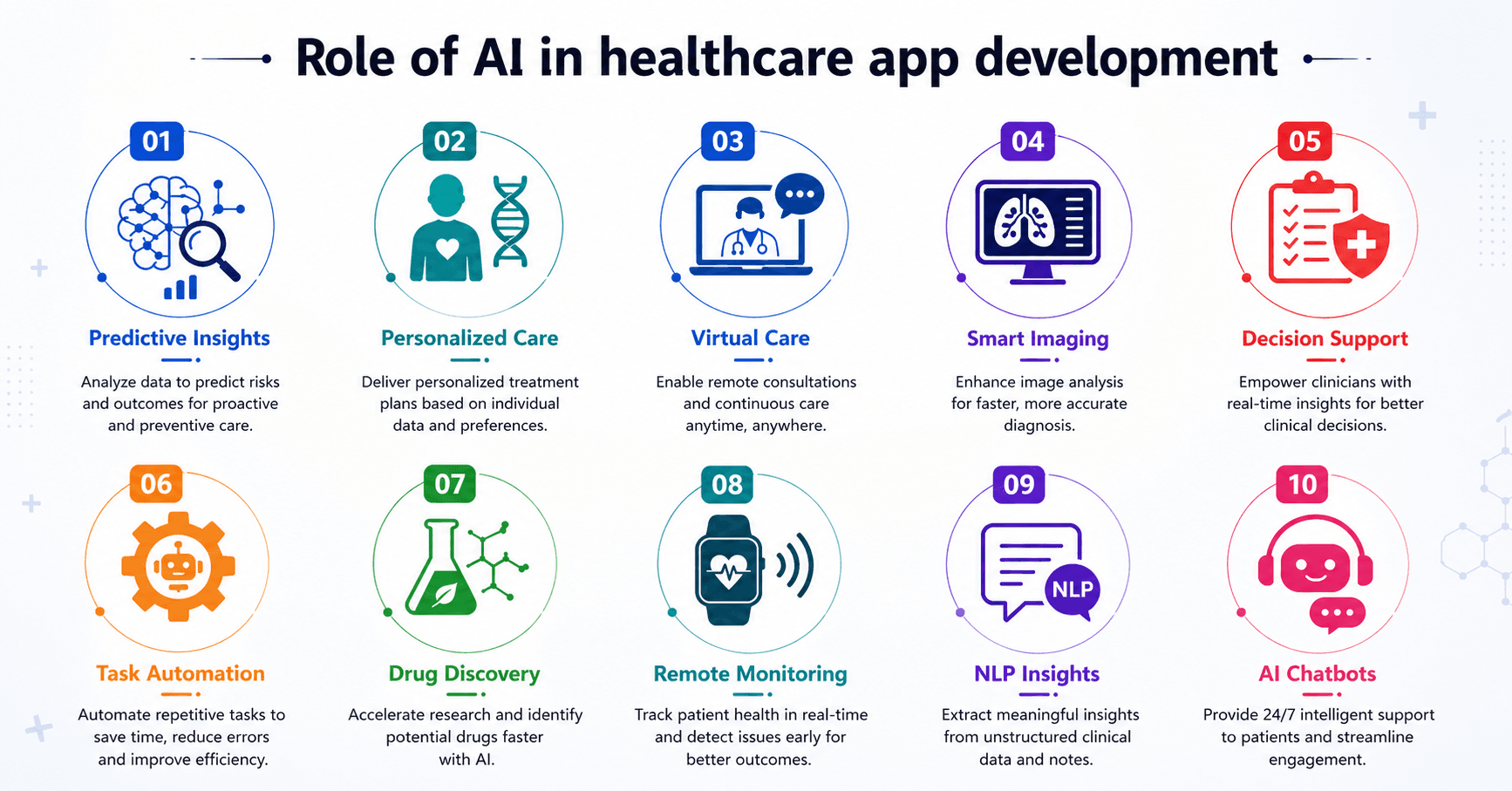
1. Predictive Insights
When it comes to the prediction of potential health alarms, AI can help healthcare providers predict patient health-related issues before they arise by analyzing the patient's medical history and lifestyle habits.
This allows a better way to improve health outcomes over the period of time. It makes easy to understand the problem and allowing timely for the implementation of preventative measures.
2. Personalized Care
AI can process large amounts of information to give clinicians accurate recommendations that improve patient outcomes and reduce the chance of errors.
AI provides each patient with care tailored to their medical history and individual needs.
3. Virtual care
As patients use telemedicine and virtual care technology, AI has become crucial to this growing field, enabling virtual consultations and diagnostic tools.
AI-powered healthcare applications can help patients complete a basic assessment of their overall health.
4. Smart Imaging
AI can enhance image analysis for faster and more precise diagnosis. By analyzing X-rays, MRIs, and CT scans, AI can detect abnormalities like tumors, fractures, or infections, sometimes identifying issues that human eyes might miss. This improves diagnostic accuracy and ensures more precise treatment.
5. Decision Support
AI helps healthcare professionals make decisions by evaluating complex medical data, research, and guidelines. AI tools deliver real-time suggestions and better treatment options, supporting doctors in making well-informed decisions.
6. Task Automation
AI simplifies administrative tasks such as appointment scheduling, billing, and patient record management. It reduces the burden and paperwork on healthcare staff.
Healthcare providers can focus more on patient care rather than lengthy paperwork. This AI assistance improves operational efficiency, speeds up health services, and reduces errors.
7. Drug Discovery
Drug discovery can be accelerated by predicting how different compounds interact with the human body. Using machine learning, AI can analyze biological data to identify promising drug candidates and predict their effectiveness.
This capability can lead to faster and more cost-effective drug creation.
8. Remote Monitoring
Wearable devices and sensors using AI allow continuous monitoring of patients' vital signs, such as heart rate and glucose levels.
These AI-powered devices provide real-time data to healthcare professionals, enabling remote monitoring and early intervention when abnormalities are detected.
9. NLP Insights
AI uses Natural Language Processing (NLP) to examine and interpret unstructured data, like doctors' notes or patient records.
It also supports transcription and document management, reducing administrative workloads for healthcare professionals.
10. AI Chatbots
AI chatbots offer immediate responses to patient queries, providing health advice, scheduling appointments, and sending medication reminders.
They can also gather important health data and direct patients to appropriate healthcare providers based on their symptoms.
The Other Side of AI: Challenges and Hurdles
Despite its many benefits, AI adoption in healthcare also presents significant challenges. Data privacy and security remain major concerns, as sensitive patient information must be protected at all costs.
Data Quality and Availability are equally critical hurdles. AI depends on accurate, well-structured data, and poor data quality can lead to biased or inaccurate models, limiting overall effectiveness.
Models that lack sufficient accuracy can create serious problems for healthcare providers. Even a small error can lead to significant clinical consequences.
High development costs also hinder the creation of AI-powered healthcare systems. This barrier can be especially difficult for mid-sized and smaller organizations to overcome.
To address these challenges, partnering with an experienced healthcare application development company can help you manage financial pressure, streamline development cycles, and ensure scalable, efficient AI healthcare solutions.
The Future: What Lies Ahead
The future of healthcare is deeply intertwined with AI. From robotic surgeries to wearable devices that enable continuous health monitoring, the possibilities are expanding rapidly.
AI will likely play a major role in analytics-driven and preventive healthcare, helping individuals stay healthier for longer. With increasing precision and reliability, Generative AI is poised to become a trusted productivity tool across hospitals, clinics, and telehealth platforms.
Future healthcare applications will leverage Multimodal AI to integrate text, images, sensor data, and biological signals. This shift from reactive treatment to predictive care will reduce hospitalization costs, improve long-term outcomes, and transform how care is delivered.
As technology continues to advance, healthcare will become more proactive, personalized, and precise.
Turning AI Potential into Real Healthcare Solutions
AI is not merely another technological trend; it is reshaping how healthcare is delivered across the globe. By improving outcomes, lowering costs, and expanding access, it has the potential to touch more lives than any innovation before it.
For organizations ready to bring AI into their digital health platforms, the path forward does not have to be complex or prohibitive. At Axonaire, we focus on designing intelligent, sustainable healthcare systems that address real problems, systems that don’t just innovate, but truly solve.
If you are interested in developing a customized healthcare application that truly understands what doctors and patients need, get in touch with our team to see how we can help.
Frequently asked questions
Turning AI Potential into Real Healthcare Solutions
If you are interested in developing a customized healthcare application that truly understands what doctors and patients need, get in touch with our team to see how we can help. At Axonaire, we focus on designing intelligent, sustainable healthcare systems that address real problems.